
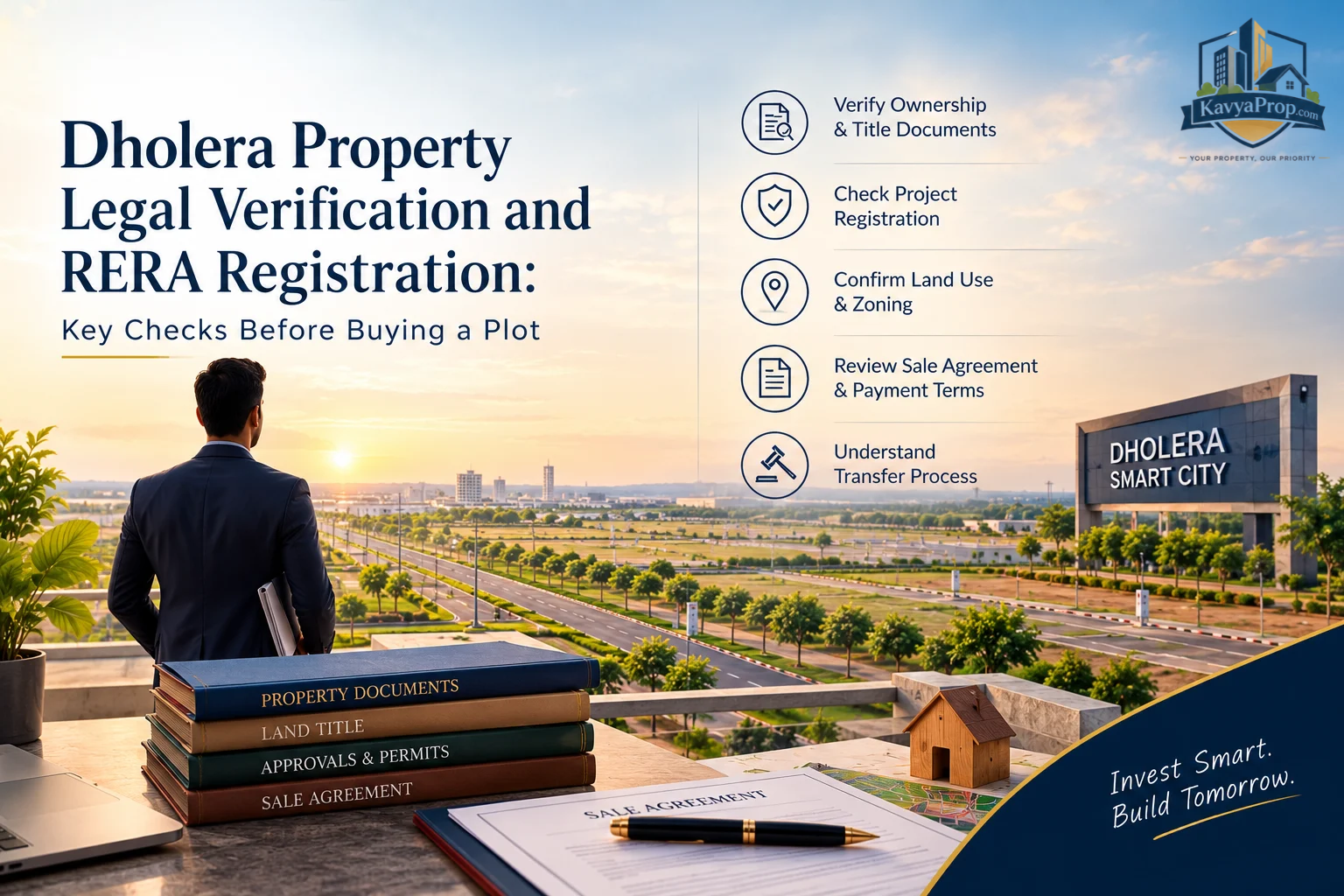
Dholera Special Investment Region (SIR) in Gujarat is attracting attention from buyers interested in residential, commercial, and industrial property. However, before investing in a plot, it is essential to understand its legal status, ownership records, applicable approvals, and transfer requirements.
Although Dholera is associated with planned infrastructure and industrial development, buyers should not assume that every property advertised in the region has the same legal status or development permissions. Careful verification can help identify potential risks and support informed investment decisions.
Dholera property legal verification involves reviewing ownership documents, confirming permitted land use, examining development approvals, and understanding the terms of the proposed transaction.
At Kavya Prop, we believe that informed property decisions begin with transparency, proper documentation, and a clear understanding of the legal checks involved in purchasing land.
Why Is Legal Verification Important Before Buying a Plot in Dholera?
Purchasing land is a significant financial commitment. A property's advertised location, price, or expected development potential does not automatically establish that the land is legally suitable for the buyer's intended purpose.
Before booking a plot, buyers should establish who owns the land, whether the seller has the legal authority to transfer it, and whether the proposed use complies with applicable regulations.
Important reasons to conduct legal verification include:
- Ownership confirmation: Establish whether the seller has the legal right to sell the property.
- Document verification: Review relevant ownership records and transaction documents.
- Land-use compliance: Confirm whether the plot can legally be used for the intended purpose.
- Approval checks: Examine applicable development and planning permissions.
- Transaction transparency: Understand payment terms, registration requirements, and contractual obligations.
These checks are important for residential, commercial, and industrial plots alike.
7 Essential Legal Checks Before Buying a Plot in Dholera
1. Verify the Land Ownership and Title Documents
Land title verification is one of the most important steps before purchasing a property.
Buyers should ask for the relevant ownership documents and have them reviewed by a qualified property lawyer. The objective is to establish the ownership history and identify any legal issues that could affect the transaction.
Depending on the property, relevant documents may include:
- Registered sale deeds and previous title documents.
- Revenue records and relevant land extracts.
- Mutation entries and supporting documents.
- Available encumbrance records and information about registered charges.
- Inheritance or partition documents, where applicable.
- Power-of-attorney documents, where relevant.
- Information about pending disputes or litigation affecting the land.
Revenue records and mutation entries are useful for verification but should not be treated as conclusive proof of ownership by themselves.
A professional title review can help determine whether the seller has the legal authority to transfer the property and whether further investigation is necessary.
2. Check the Project's Registration and Applicable Approvals
Before investing in a plotted development, ask the developer or seller for details of the project's registration status and the approvals applicable to it.
Where a real estate project is legally required to be registered, buyers should verify its registration through the relevant official authority. They should also confirm whether the registration details correspond to the actual project being offered.
Review the available documents for:
- Project and developer details.
- Applicable registration information.
- Sanctioned layout plans, where required.
- Development permissions.
- Declared project timelines, where applicable.
- Relevant approval conditions and restrictions.
Do not rely solely on advertisements, brochures, or verbal assurances. Ask for documentary evidence and independently verify important claims.
Registration under a real estate regulatory framework does not, by itself, guarantee clear ownership, unrestricted construction rights, or a particular investment return.
3. Confirm the Permitted Land Use
Not every plot can legally be used for residential, commercial, or industrial purposes.
Before purchasing land in Dholera, verify its classification and the permitted use under the applicable development plan and local regulations.
Depending on the property, relevant checks may include:
- Land-use classification and zoning provisions.
- Agricultural land restrictions.
- Land-use conversion or non-agricultural permissions, where required.
- Approved layout and subdivision permissions.
- Development and building permissions.
- Environmental or other statutory clearances, where applicable.
For example, a buyer intending to construct a residential property should not assume that a plot advertised for investment can automatically be used for residential construction.
Always confirm the permitted use with the competent authority before making a financial commitment.
4. Verify the Exact Plot Location and Boundaries
The exact location of a plot is an important part of legal due diligence.
Properties marketed as being in Dholera may be situated in different villages, planning zones, or surrounding areas. Their legal status, permitted uses, and development conditions may therefore differ.
Before proceeding, obtain and verify:
- The survey number or other applicable land identification.
- The precise location and boundaries of the parcel.
- The project layout and plot number.
- Relevant planning and zoning information.
- Documents showing the property's relationship to the applicable development area.
Where necessary, arrange a site inspection and seek professional assistance to confirm that the physical location matches the documents.
Proximity to a proposed road, industrial development, or infrastructure project does not automatically establish that a plot has received the necessary approvals.
5. Review the Sale Agreement and Payment Terms
Before signing a booking form, allotment letter, or sale agreement, carefully review the terms of the proposed transaction.
Pay particular attention to:
- Plot number, area, and boundaries.
- Total purchase price and payment schedule.
- Applicable taxes, stamp duty, and registration charges.
- Possession and transfer conditions.
- Cancellation and refund provisions.
- Responsibilities of the buyer and seller.
- Promises relating to infrastructure and development.
- Representations regarding ownership and approvals.
Buyers should also understand any statutory requirements governing advance payments and agreements for sale.
Avoid relying exclusively on verbal commitments about future appreciation, possession, construction permissions, or infrastructure facilities. Important promises should be documented and checked against the relevant approvals and contractual terms.
6. Understand the Registration and Ownership Transfer Process
A booking receipt or allotment letter does not necessarily mean that legal ownership has been transferred.
Depending on the transaction, ownership transfer may require execution and registration of a sale deed, payment of applicable stamp duty and registration fees, and completion of other formalities.
Before proceeding, clarify:
- Who is legally entitled to sell the property.
- Which document will transfer ownership.
- Whether the property details match the transaction documents.
- Which statutory charges and registration fees apply.
- What steps are required after registration to update relevant records.
Keep copies of the registered documents, agreements, receipts, and transaction correspondence.
Consult a qualified property lawyer to understand the correct transfer procedure for the specific land parcel.
7. Verify the Seller or Developer's Credentials
Buyers should verify the identity and credentials of the person or company offering the property.
Request the relevant business details, ownership documents, project approvals, and registration information where applicable.
Before making a payment, confirm:
- The identity of the legal owner or authorized seller.
- The developer's details and role in the project.
- The authority of any representative acting on the seller's behalf.
- The authenticity of the documents supplied.
- The account or entity to which the payment is being made.
Avoid transferring money to unrelated individuals or relying on unverified certificates and screenshots.
If any important information is missing or inconsistent, seek written clarification and professional advice before proceeding.
Common Legal Mistakes to Avoid When Buying Dholera Plots
Even experienced buyers can overlook important documentation requirements when focusing mainly on price or location.
Some common mistakes include:
- Purchasing without examining the ownership history.
- Assuming that every plot marketed in Dholera is approved for construction.
- Treating a booking receipt as proof of ownership.
- Ignoring land-use restrictions and development conditions.
- Relying on verbal assurances instead of written agreements.
- Overlooking cancellation clauses and additional charges.
- Assuming that future infrastructure guarantees property appreciation.
- Making payments before verifying the seller's authority.
A careful review of the relevant documents can help buyers identify issues before entering into a binding transaction.
What Should You Do If You Discover a Legal Issue?
If you discover discrepancies in the ownership documents, project approvals, plot boundaries, payment terms, or other important details, pause the transaction until the issue has been investigated.
Consider the following steps:
- Collect the booking form, agreement, payment receipts, promotional material, and relevant correspondence.
- Ask the seller or developer for written clarification.
- Verify the available information through the relevant official records.
- Consult a qualified property lawyer to assess the issue and potential remedies.
- Where appropriate, consider approaching the competent regulatory authority, consumer forum, or another relevant authority, depending on the nature of the dispute.
The appropriate remedy depends on the circumstances and the applicable law. Buyers should avoid making further payments until significant legal or documentation concerns have been addressed.
How Kavya Prop Helps Buyers Explore Property Opportunities
Kavya Prop is a real estate consultancy focused on property opportunities in Dholera SIR and Delhi NCR.
We understand that buyers need clear information about the properties they are considering, the documents available, and the questions they should resolve before making a financial commitment.
Kavya Prop helps prospective buyers explore property options and understand the importance of verifying ownership details, applicable approvals, and transaction documentation.
Our approach focuses on:
- Helping buyers understand the importance of property documentation.
- Providing information about available property options.
- Highlighting essential ownership and approval checks.
- Assisting prospective buyers in exploring residential, commercial, and industrial plots.
- Encouraging independent verification before a purchase decision.
Each property should be assessed individually because its legal status and development conditions may differ. Buyers should obtain the relevant documents and seek professional legal advice wherever necessary.
To learn more about available property opportunities, visit Kavya Prop at https://kavyaprop.com/.
Conclusion
Buying a plot in Dholera requires careful consideration of ownership records, land-use permissions, project approvals, contractual terms, and the legal transfer process.
Proper legal verification can help buyers identify potential concerns, understand the conditions attached to a property, and make decisions based on reliable documentation rather than promotional claims.
Before booking a plot, review the relevant documents, verify important details through official records, and consult a qualified property lawyer when needed.
At Kavya Prop, we encourage prospective buyers to prioritize transparency, documentation, and informed decision-making when exploring property opportunities in Dholera SIR and Delhi NCR.
Request a Quote
Are you planning to purchase a residential, commercial, or industrial plot in Dholera SIR? Looking for property options that match your location preferences and budget?
Connect with Kavya Prop to discuss your requirements and request a personalized consultation.
Our team can help you explore available property opportunities and understand the documentation you should review before making a purchase.